Express 24h delivery for orders placed before 1pm
- Promotions
- Kits
- Washing
-
Rim & Tire
Rim & Tire - Sale
- New
-
Decontamination
Decontamination - Sale
- New
-
Correction & Polishing
Correction & Polishing - Sale
- New
- Protection
- Interior
-
Windows
Windows - Sale
- New
-
Accessories
Accessories - Sale
- New
- Others
- Professional products
- Brands
- My pro area
- Wishlist
- Blog
KOCH CHEMIE H9.1 F6.01 M3.02 P3.01
- Products: H9.1, F6.01, M3.02, P3.01.
- Manufacturers: KOCH CHEMIE.
- Packaging: 250ml or 1L.
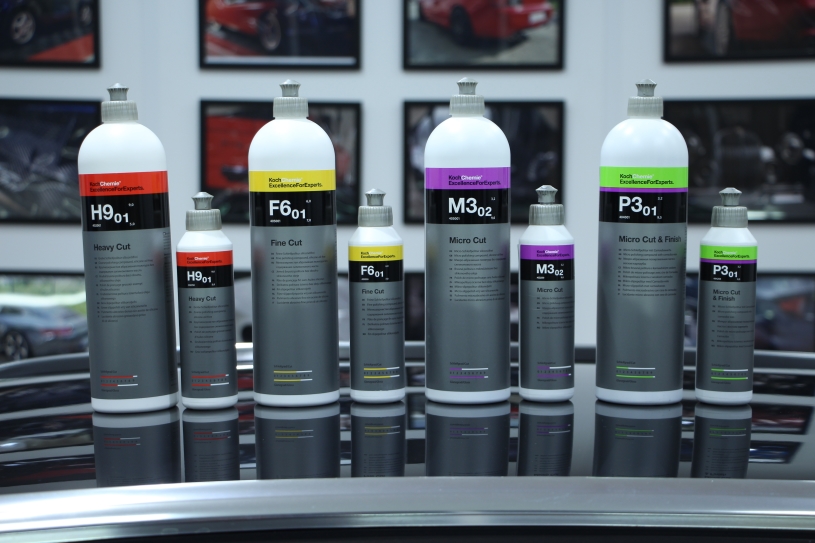
KOCH CHEMIE is renewing its abrasive range. Already one of the current references, the German brand is introducing an update to 4 polishes in their range (the H7.01 remains unchanged). The already excellent references we knew (H8.02, F5.01, M2.01, P2.02) have been further refined for even better cutting performance.
Thus, the H8.02 becomes the H9.01, the F5.01 becomes the F6.01, the M2.01 becomes the M3.02, and finally the P2.02 becomes the P3.01).
In this presentation we will compare the old and new references and assess whether or not the evolution is convincing.
Identification:
A brief note first on the meaning of the polish indices in the range, to try to understand what H9.01 means, for example.
At KOCH CHEMIE, everything is very well organized, coded, and every color, index or superscript has its own importance and meaning.
Each product category has its own color. Black, for example, is reserved for products related to bodywork and paint/varnish treatment. Polishes therefore fall into this category.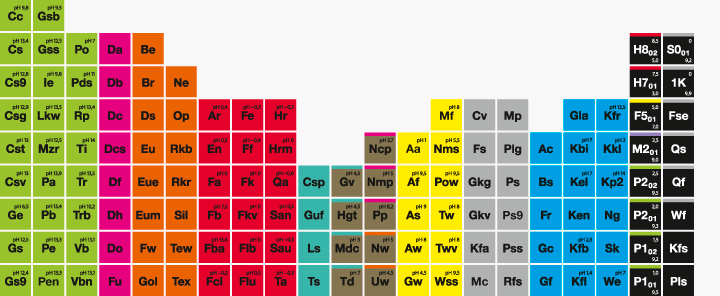
Within the polish category, there is also a second color code. On the black background, there is an upper band that classifies the nature of the polish. In this case, red is reserved for highly abrasive polishes (compounds), yellow for intensive ones, purple for finishing polishes, and green/purple for ultra-finishing ones containing carnauba wax.
Finally, a polish is named as follows:
The first letter of its name in English, then its abrasiveness level, followed by its revision number. A superscript indicates its exact cut, and a subscript its resulting finish level.
So if we take the previous H8.02 as an example, we get: Heavy Cut (polish with strong cutting power), cut of 8, 2nd revision, with an exact cut of 8.5 and a finish level of 5.0.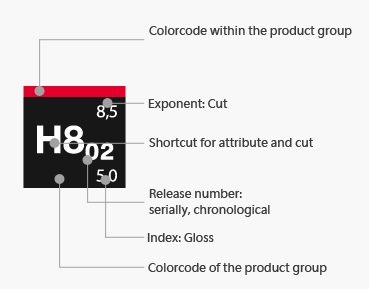
Presentation of the new polishes:
H9.01:
The H9.01 therefore replaces the H8.02 with an improvement mainly in terms of cut (abrasive power). The finish between the two is the same, at least on paper.
This is evident when comparing the two.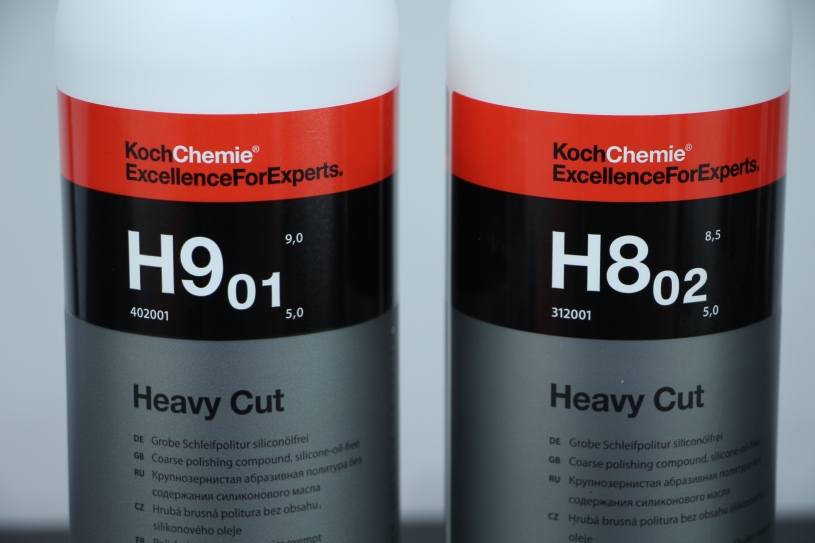
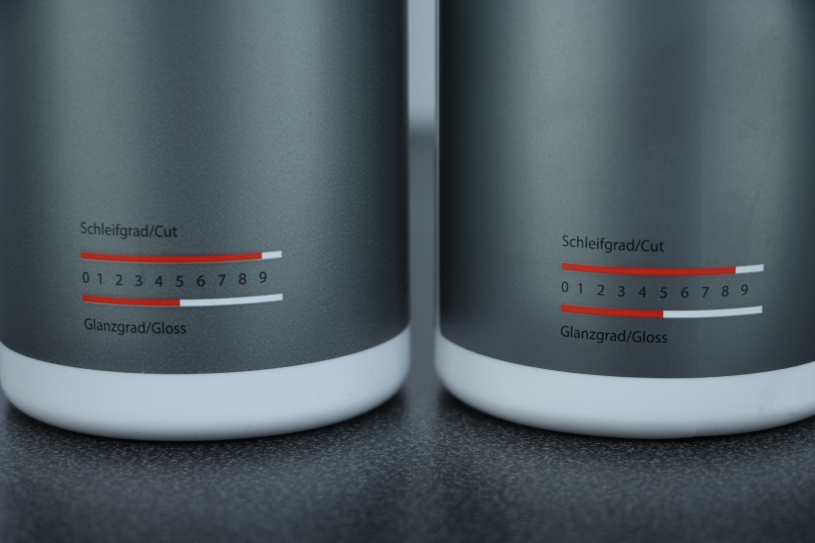
The difference in cut is fairly small. We go from 8.5 to 9.0. But does the H9.01 actually make a difference over the H8.02 in real-world use? We will look at this in a practical case study.
As with its predecessor, the H9.01 can and should be used with hard pads specifically designed for compounds in order to take full advantage of the cutting potential sought with this type of polish.
Thus, pads from the brands Lake Country (purple, yellow), Rupes (UHS, blue or up to green), Flexipads (white, orange) will be perfectly suited.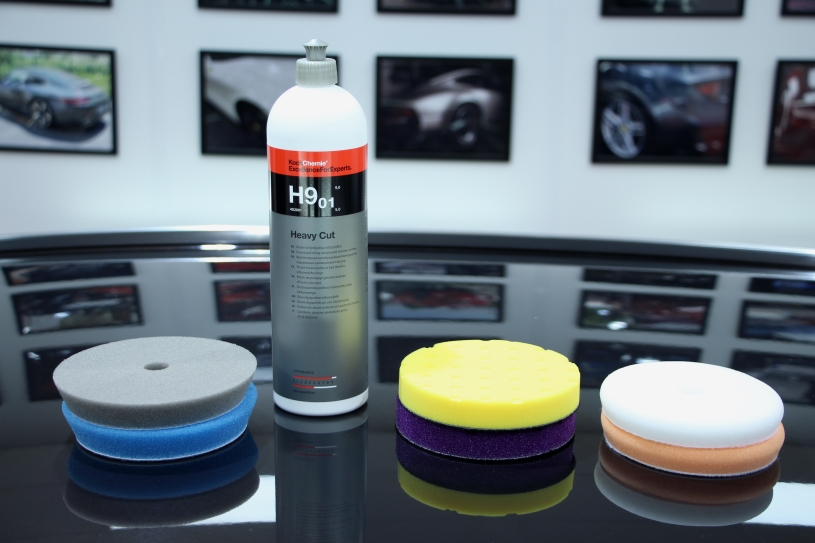
For the H9.01 test, I deliberately chose a Hard pad (Lake Country purple) but not too aggressive, to give priority to the polish rather than the pad, which could have skewed the test.
The test vehicle is an AUDI, a hard original lacquer that often requires the use of compounds for quick and effective correction.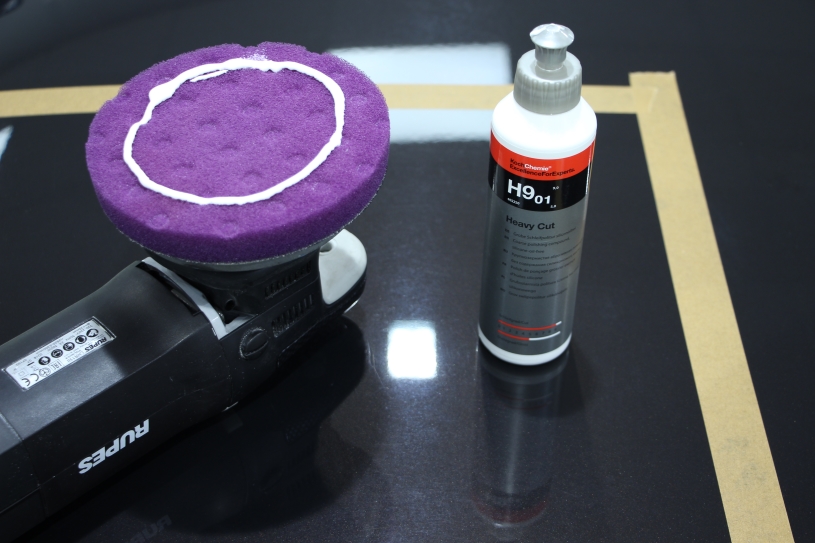
On a 60x60cm test area, we work the H9.01 (applied in a peripheral circle on the pad) in crossed straight passes at maximum speed (6 on the RUPES LHR15 mk2).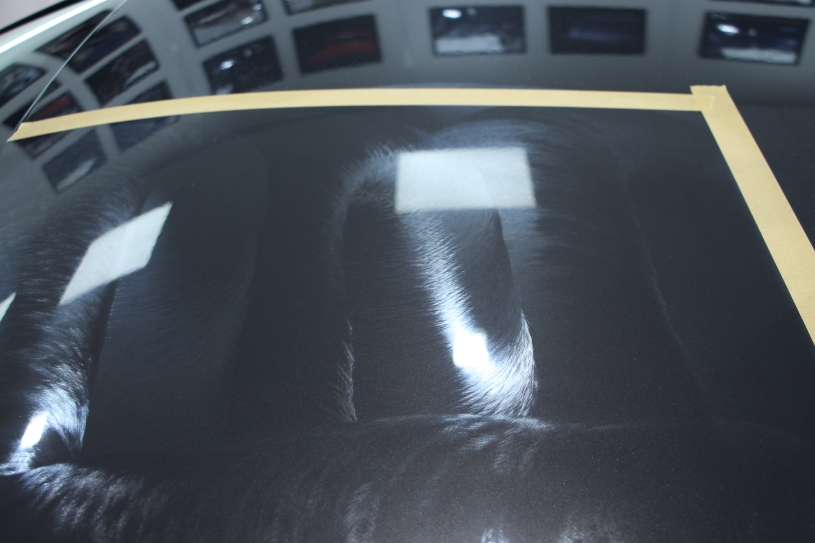
The H9.01 carries over the same working advantages as the H8.02, namely a very good working capacity (you can work it for a long time before it breaks down), low dust, and fairly easy wiping. You will also find the same consistency as the H8.02 — a polish that is not too pasty, unlike certain other references from other brands.
Once the polish is wiped off using an isopropyl alcohol-based cleaner, the result is undeniable. The cut is almost perfect on the first pass, and above all the finish level is excellent. That was the big question given how superb the finish left by the previous H8.02 was. In the end, we genuinely gain in pure cutting capacity, without too much extra dust, at the same finish level.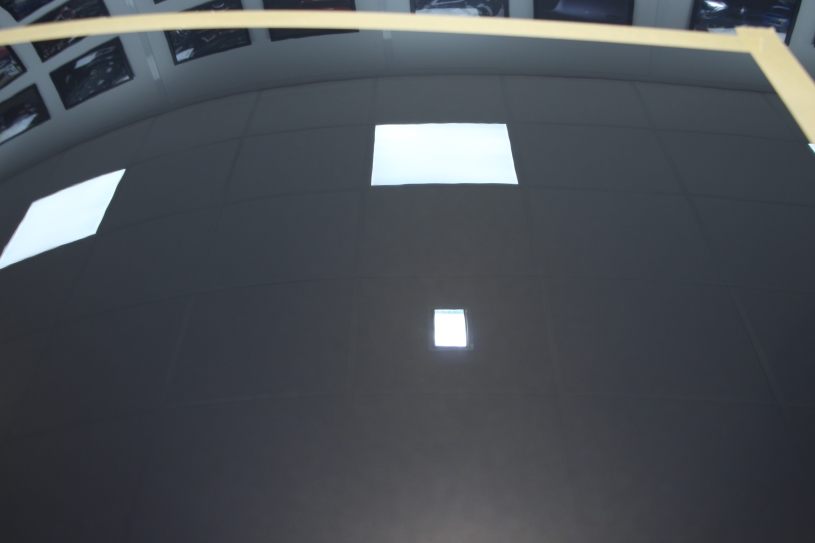
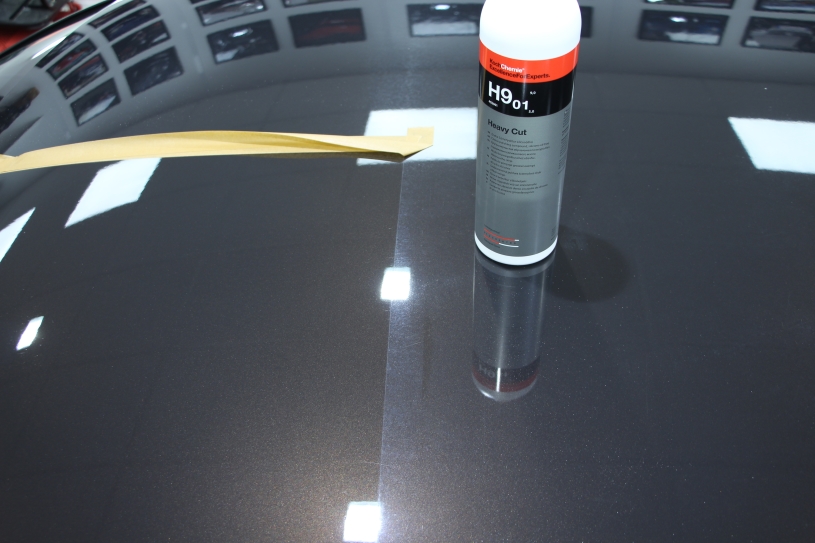
On a forgiving paint color such as silver greys, whites, or other light non-lacquered shades, you can therefore almost get away with a single well-worked correction pass using H9.01 with a semi-hard pad for an excellent, deliverable level of correction and finish. A real plus!
On lacquered shades or delicate surfaces (here tested on lacquered black pillars), it is clear that using H9.01 with a hard pad leaves characteristic defects that will necessarily need to be addressed with a finishing polish at minimum (M3.02 for example).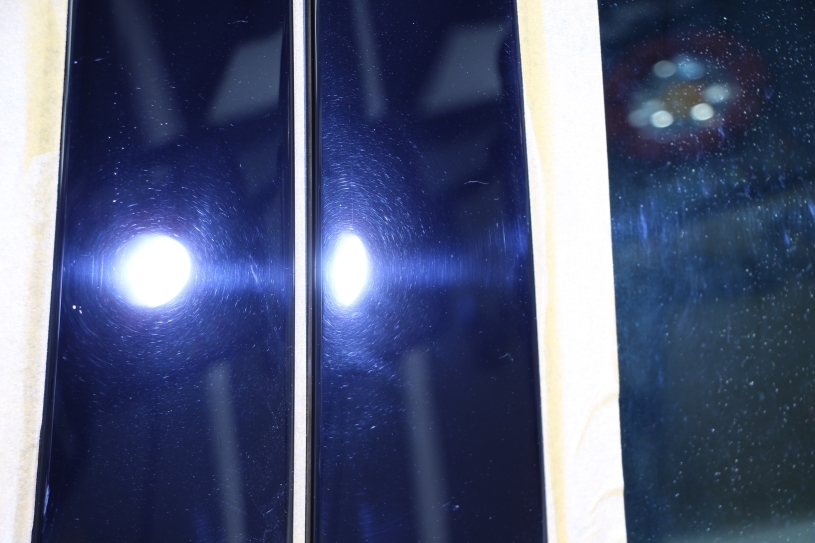
In conclusion, the H9.01 carries over the same ingredients as the H8.02 while genuinely improving overall cutting efficiency without compromising the finish, which remains just as good. A proven reference, now improved!
F6.01:
The F5.01 has also received its direct successor: the F6.01.
The very great advantage found with this update is the availability of the reference in 250ml, which was not the case with the F5.01. Indeed, since not everyone is a professional, a one-liter bottle is not justified if you are simply treating your personal car. A 250ml bottle is therefore very welcome!
From now on, the F6.01 will be available in 250ml and 1L.
Beyond that, on paper we also see an increase in the cutting power of the polish (going from 5.0 to 6.0 in cut).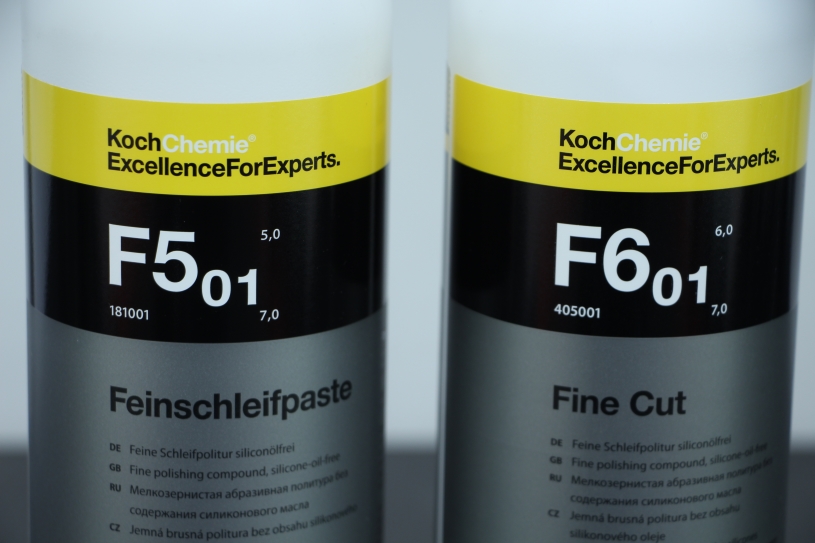
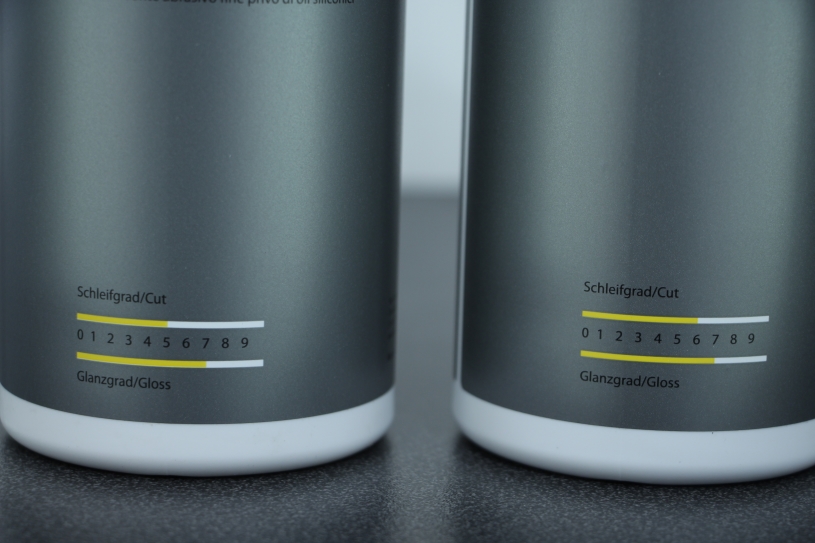
The F6.01 is what is known as an intensive polish (Medium cut) — a polish that allows a perfect balance between correction capacity and finish. A polish to use on single-pass renovations for very lightly marked vehicles, or when a good all-round compromise is desired.
Thus, F6.01 will be used with a medium pad (polishing pad) — for instance a white Lake Country pad, a yellow Flexipads pad, or a green-to-yellow Rupes pad.
In this test, once again to prioritize the polish over the pad, I deliberately chose to use a traditional soft polishing pad — the white Lake Country in this case.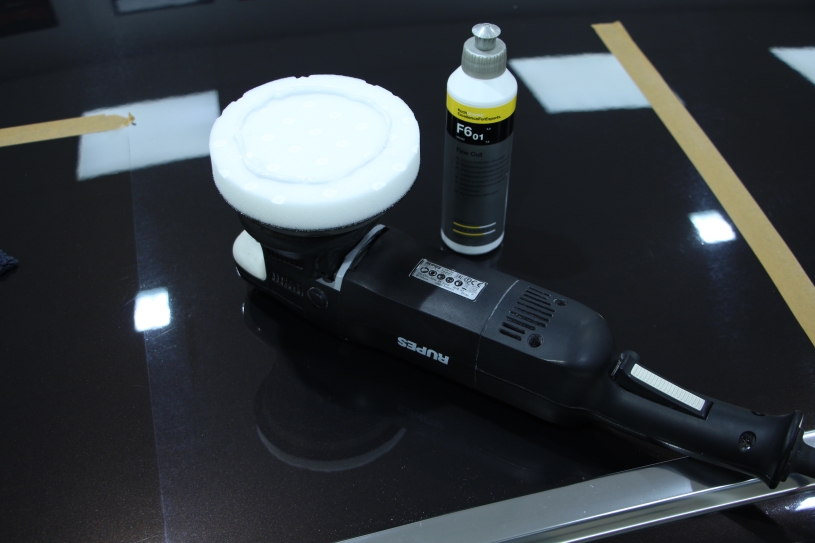
We section our test element once again on the same vehicle. We work the polish following the same process as for the H9.01 presented previously.
After extended working of the polish (the F6.01 can be worked for a very long time) on the test area, the result is particularly good. On one hand because the finish is flawless (fine sanding marks, holograms, etc. are absent), but on the other hand because the cutting capacity of this polish is excellent! The F5.01 was already very good in this regard, but here we clearly move up a level.
Very honestly, there is not much left for the H7.01 to do if you use the F6.01 with the right pad.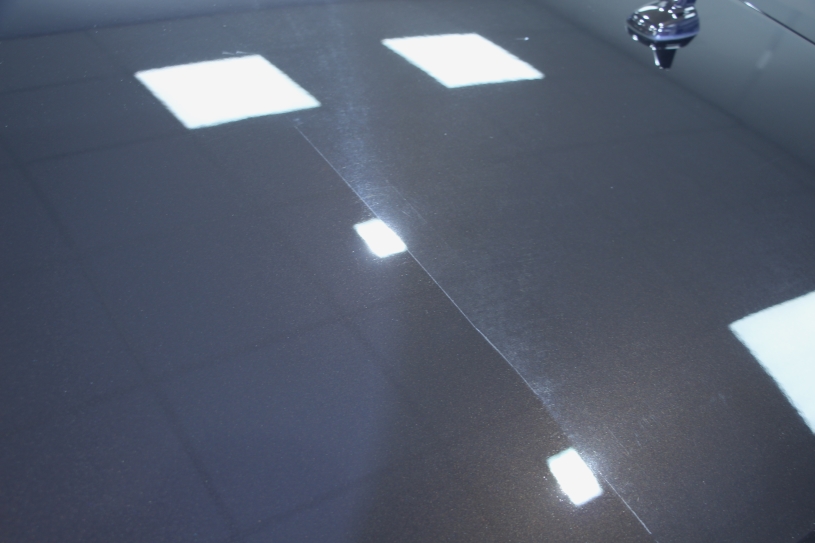
Of course, deep or very deep defects will only be reduced, but that is already excellent, especially on a hard lacquer.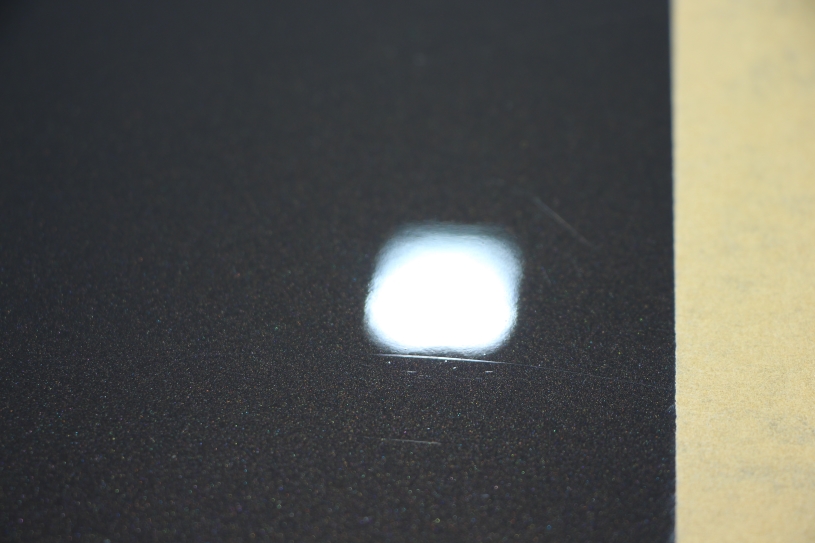
If you work F6.01 on a delicate area such as the lacquered black door pillars, you notice an improvement in perceived finish compared to H9.01 (still improvable, of course) but the cut remains very solid.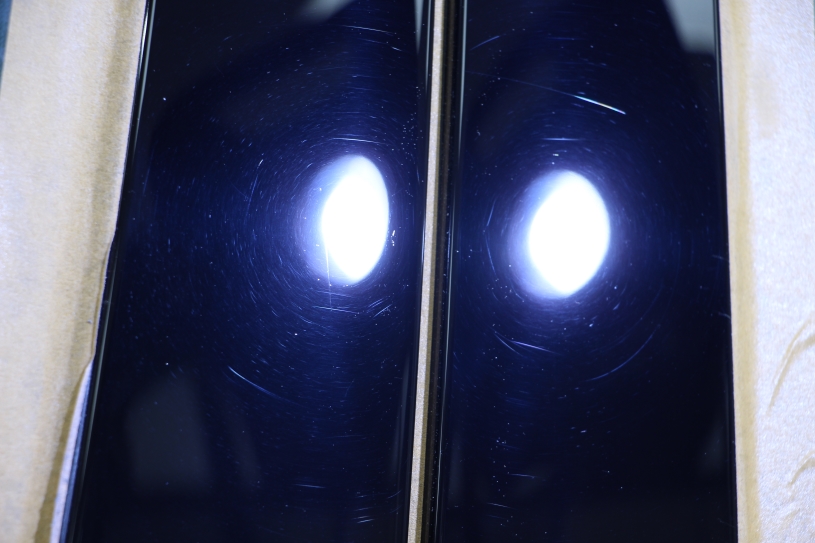
In conclusion, the F6.01 is a very pleasant and impressive surprise, as it manages to push the performance of the F5.01 almost to compound level (nearly comparable to an H7.01) while delivering a perfect finish. The ultimate tool to have if you want effective correction of a lightly micro-scratched vehicle in a single pass while ensuring a top-tier finish!
M3.02:
Once again, KOCH CHEMIE gives its finishing polish a little more correction power while maintaining the same level of finish. Paradoxical, you might say? Not really...
We go from a cut of 2.5 to a cut of 3.2, which is barely one level of cut gained.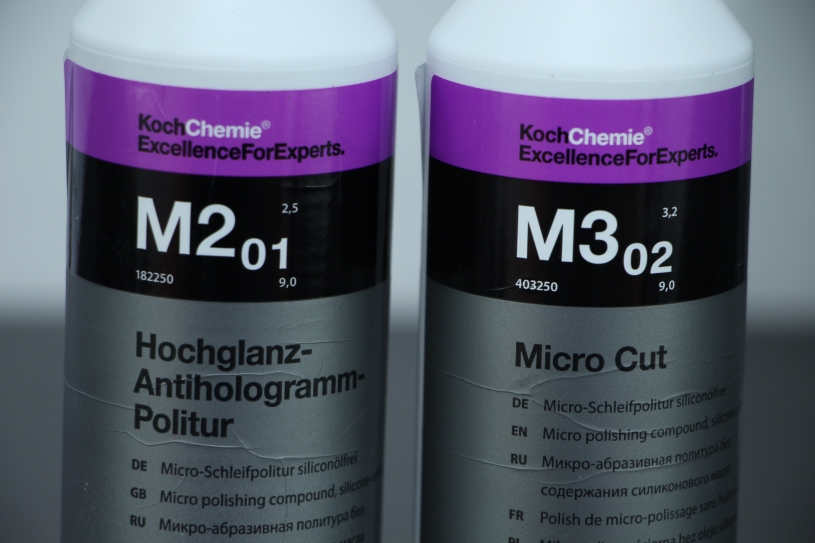
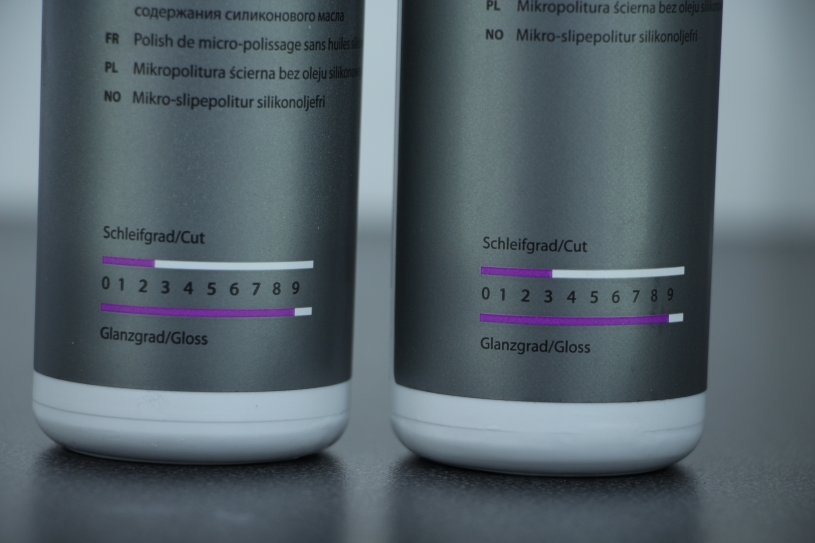
M3.02 is a finishing polish, meaning you should not expect great correction from it but rather an exemplary finish. M3.02 will thus be used directly after an H9.01 to correct the fine residual defects left by the latter, or after F6.01 on delicate paint colors (solid black, for example) for a top-level finish with no defects.
Therefore, M3.02 will be used with a pure finishing pad or even with a glaze pad if you want a perfect finish on the most fragile varnishes or lacquers.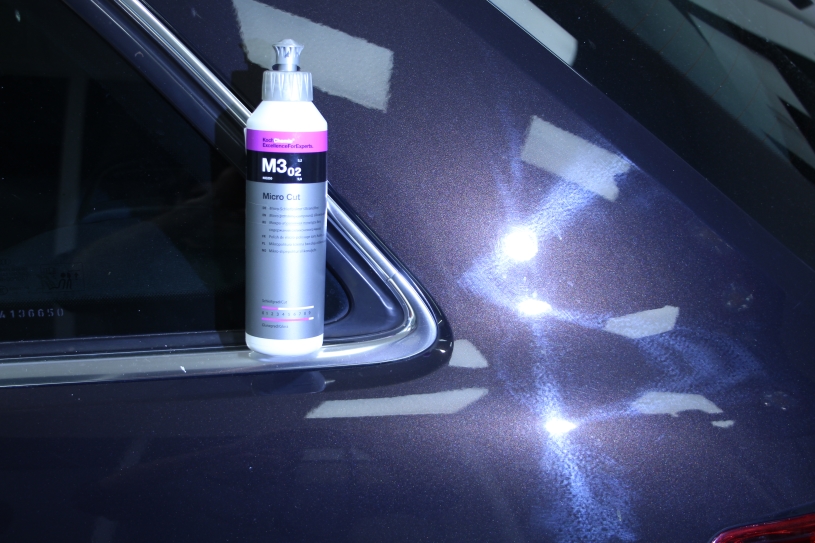
On our test vehicle, I deliberately performed a Hard decontamination and applied firm pressure to create fine defects (clay marring) visible in the photo above (fine sanding haze). There are also some fine defects on the element to be treated (fine micro-scratches).
The pad tested with the M3.02 is a black Lake Country finishing pad.
There is no need to apply too much polish to the pad; work at speed 4-5 on the orbital, which will be sufficient to achieve a satisfactory result.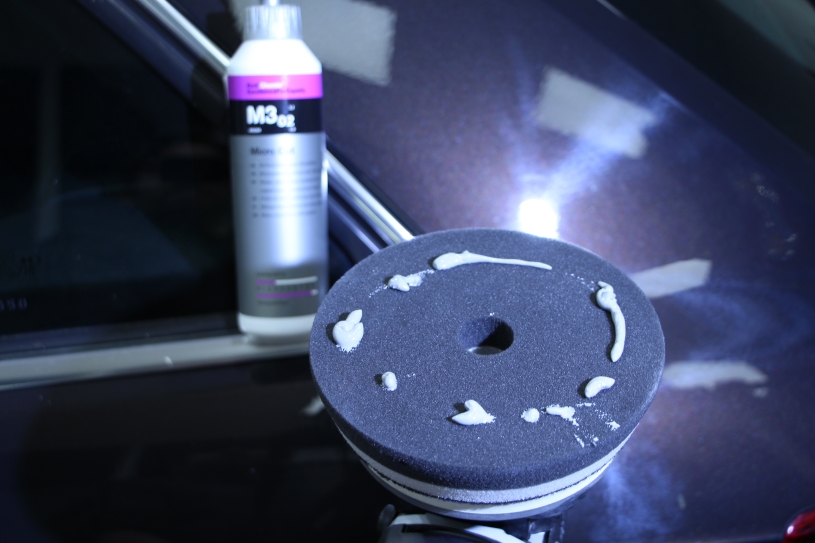
After working the polish (still as pleasant to work with as the old M2.01), the finish is beyond question: perfect! That said, it should be noted that KOCH CHEMIE has not improved the ease of wiping off the M3.02 compared to the M2.02 — it is quite greasy and therefore quite sticky when wiping. Other finishing polishes from competing brands perform better in this regard.
On the other hand, the cutting capacity is remarkable for a finishing polish. The defects mentioned earlier are removed without issue while still delivering an unrivaled finish.
Deep or moderate defects will of course remain, but that is not what we ask of a finishing polish.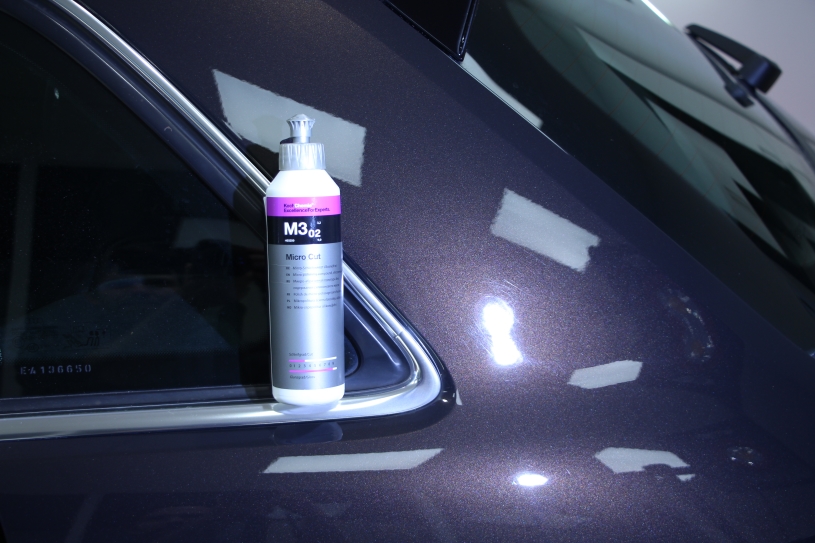
The sensitive areas (lacquered black pillars) are also "finished" perfectly after applying M3.02 to the element previously polished with H9.01.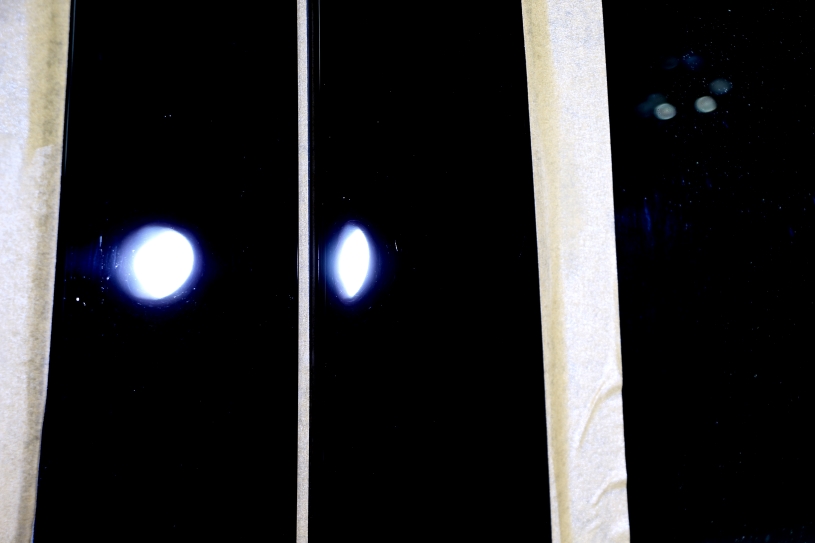
No major evolution in the end for this reference — the M2.01 was already very good. The M3.02 improves cutting capacity slightly while still delivering a flawless finish. However, improved ease of wiping would have been welcome.
P3.01:
The last polish to be renewed: the P2.02, which becomes the P3.01.
There is no need to go into lengthy detail about it, as it is essentially the M3.02 with simply carnauba wax added — just as the P2.02 was with the M2.02 at the time. You will thus find the same cutting capacities as the M3.02 but with an even higher level of gloss (barely noticeable on a small surface).
Worth noting, however, is the much greater ease of wiping off the P3.01 compared to the M3.02. The carnauba effect demands it...
The protective aspect provided by P3.01 is immediately apparent.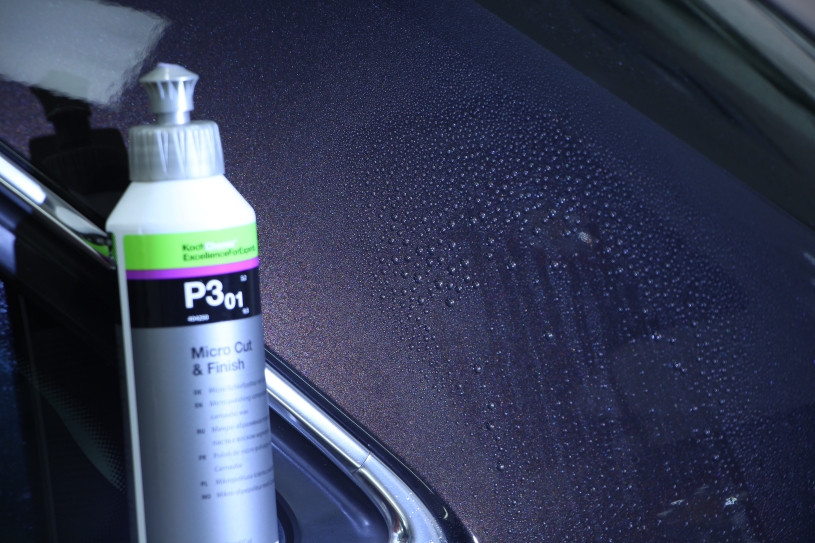
In the end, no major change here either — the same characteristics as the P2.02 are retained while improving correction capacity.
Useful for those working on tight schedules who want to apply protection to their car directly while performing the finishing polish.
General conclusion:
KOCH CHEMIE continues to progress, managing to improve references that were already among the best on the market. Efficiency is gained without losing the fundamentals.
That said, it should be noted that prices are slightly higher compared to previous versions, with the F6.01 in particular seeing a significant increase over its predecessor. Quality comes at a price, all the more so as the F6.01 is truly an excellent polish — very versatile — that will suit a wide range of situations.
References you absolutely must have in your polishing arsenal without delay!
Advantages
+ Polish performance.
+ Low dust.
+ Finishing capacity of all polishes.
Disadvantages
- Rising prices.
- (Relative) difficulty wiping off the M3.02